
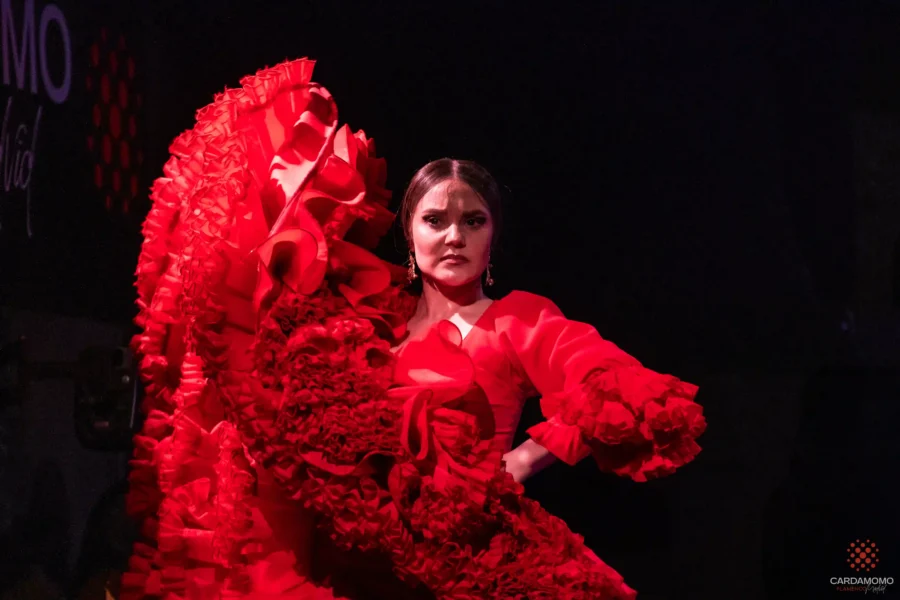
Some dresses are worn and some dresses dance. The bata de cola is one of the latter. It’s not just a beautiful gown: it’s an extension of the dancer’s body, a piece with a life of its own that can weigh several kilos and that, in the right hands, becomes pure poetry on stage. Mastering it is one of the greatest tests of flamenco dance.
What the bata de cola is
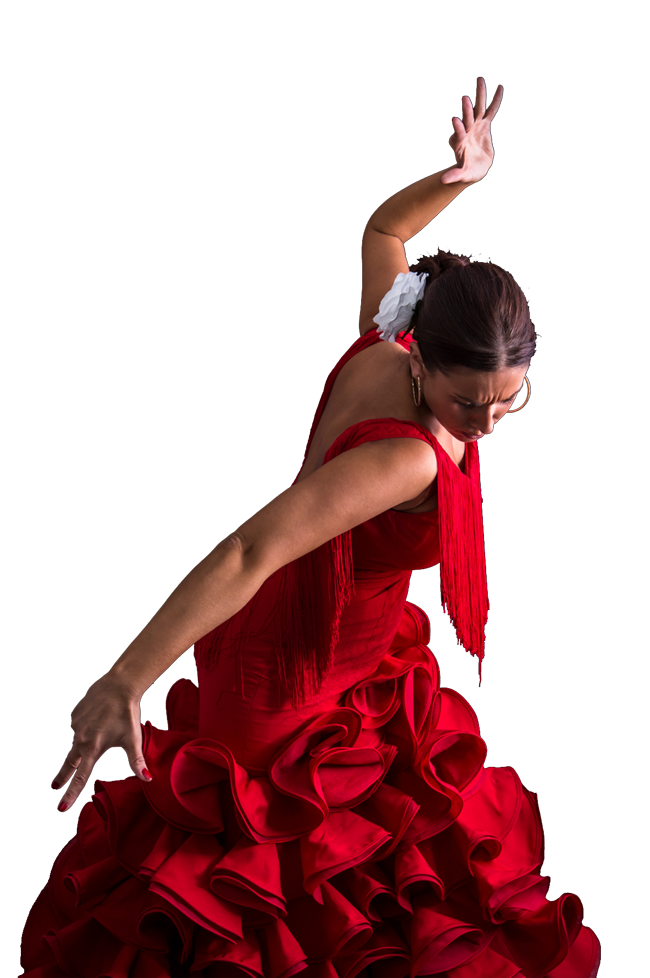
The bata de cola is a long-skirted flamenco dress that extends at the back into a train of ruffles, usually finished with layers of frills. It can have anywhere from one to seven ruffles, and its length and weight vary by design, but it always shares one trait: it isn’t a dress you wear, it’s a dress you handle.
Unlike the feria flamenca dress, the bata de cola is a professional dance garment. Its train drags along the floor and the dancer must move it, throw it and gather it with her body, barely using her hands. Therein lies its difficulty and its magic.
The origin and history of the bata de cola
The bata de cola has its roots in the 19th century. It’s believed to have evolved from the trained gowns worn by high-society women, which flamenco gradually took in and transformed into a stage garment. By the end of that century it was already common in the cafés cantantes, the cradle of professional flamenco.
Over time it was refined: it grew lighter, adapted to dance and went from being a simple dress to another expressive instrument. Great dance figures took it to its fullest expression and turned it into a symbol of the most classic and elegant flamenco.
How to dance with a bata de cola
Here’s the real challenge. Dancing with a bata de cola demands years of specific technique: you have to learn to move several kilos of fabric with footwork, hip turns and precise movements, so that the train flies, draws waves in the air and falls exactly where the dancer wants.
Bad handling shows at once: the train tangles, trips or falls without grace. But when it’s mastered, the effect is hypnotic: the fabric seems to come alive and extend every movement of the body. That’s why they say the bata de cola isn’t danced with the feet, but with the whole body and, above all, with the head.
The great masters of the bata de cola
The history of flamenco is full of dancers who made the bata de cola their signature. Names like Pastora Imperio, Matilde Coral —creator of a whole school on its handling— or Carmen Amaya paved the way and proved that this garment, well mastered, can move audiences like few things in dance.
Today, the great dancers keep cultivating that art, keeping alive a tradition that demands discipline, strength and an elegance that only years of work can give.
The bata de cola live in a tablao
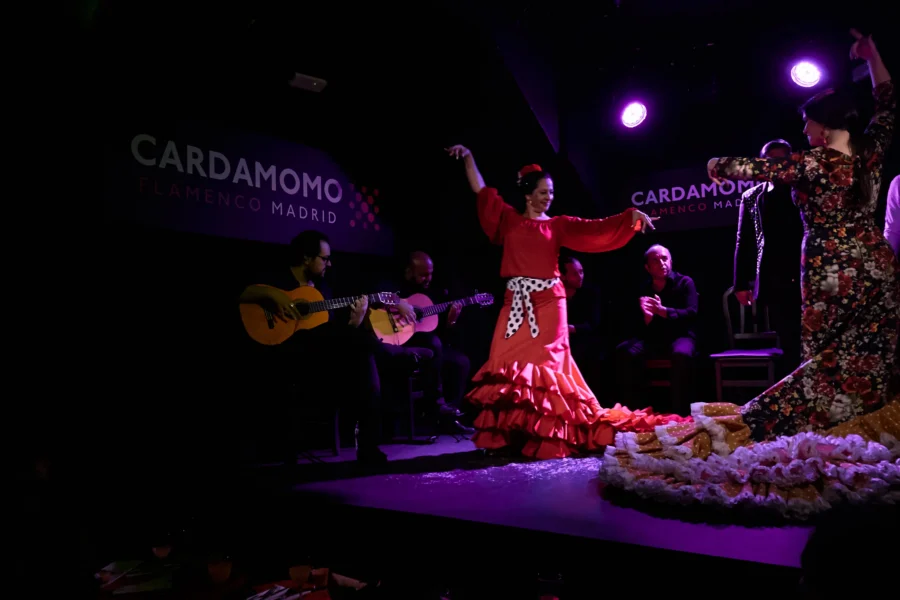
Seeing a bata de cola in a video is one thing. Seeing it a few metres away, in the half-light of a tablao, is quite another. You hear the fabric brushing against the floor, you feel the air stirred as the train flies, you appreciate the absolute control every movement demands.
At Cardamomo, a reference for flamenco in Madrid since 1994, dancing with a bata de cola is one of those breathtaking moments. If you want to understand why this garment is so special, come and see it live: it’s the best way to discover all that fits into a few metres of fabric. And if you’re interested in flamenco costume, take a look too at our article on the flamenca dress.