
The 80s in flamenco were not a simple continuation of the past, but a decade of unprecedented commercial and technical expansion. Following the rupture of the previous decade, singing became professionalized for mass audiences. It was the moment when flamenco learned to coexist with the record industry and major stages, without losing the depth of the “quejío.”
Flamenco in the 80s: a decade of change
In this period, the genre underwent a structural transformation. Singers stopped relying exclusively on private gatherings or small tablaos to become figures of popular culture.
The key to the 80s was the coexistence between orthodoxy and the search for new audiences. While some artists refined the classic canon, others paved the way for “flamenco song,” a phenomenon that allowed flamenco to play on every radio station in the country. If you want to see how this revolution was forged, you can read about the flamenco singers of the 70s.
80s Flamenco singers who defined a generation
Below, we analyze the figures who, far from stagnating, used this decade to raise the bar for “cante jondo.”
Camarón de la Isla
In 1981, Camarón published Como el agua, marking the beginning of a stage of absolute maturity. During the 80s, his figure became iconic, causing both the gypsy people and the general public to elevate him to the category of a myth. Camarón proved that thousands of records could be sold while maintaining a vocal execution that bordered on the impossible.
El Capullo de Jerez
Miguel Flores held the flag of rhythm and spontaneity throughout the 80s. Faced with major productions, he represented the truth of the Santiago neighborhood. El Capullo reminded the world that flamenco, before being an industry, is a way of celebrating life.
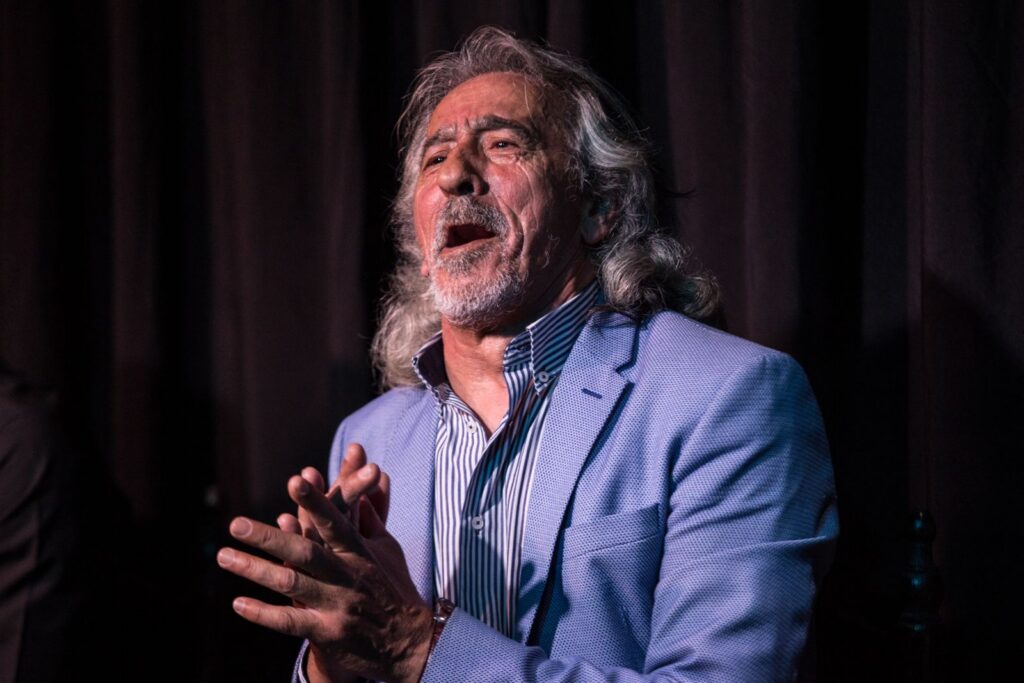
El Capullo de Jerez, icono del compás y la verdad festiva de Jerez en los años 80.
Enrique Morente
Morente dedicated the 80s to literary and musical research. Albums such as Sacromonte (1982) or Cruz y Luna (1983) are examples of how to integrate classical poetry with an avant-garde vision. Morente not only sang, he thought of flamenco as an art in constant motion.
José Mercé
In 1983, by the hand of Isidro Muñoz, Mercé launched Verde Junco, a record that placed him in the front line of singing for the general public. He achieved something extremely difficult: bringing the pure essence of Jerez to a polished and elegant production. His merit was to make the old-fashioned singing sound modern and accessible.
Juan Peña El Lebrijano
His great milestone of the decade was Encuentros (1985), a historical collaboration with the Tangier Orchestra. El Lebrijano was the first to understand that the root of flamenco and Andalusi music were two branches of the same tree. His contribution was fundamental for the international opening of the genre.
Carmen Linares
In 1988, with her album Cantaora, Carmen Linares established herself as the leading female voice. Her rigor and her ability to master all styles gave her an authority that few artists achieve. Carmen dignified the role of the female singer as a guardian of the canon.
Chiquetete
Antonio Cortés Pantoja was responsible for the “flamenco song” phenomenon. With hits such as Aprende a soñar (1982), he achieved astronomical sales figures. Although his style bordered on pop, his singer technique was still there, serving as a gateway for an entire generation to approach flamenco.
The transition from traditional flamenco to new styles
By the end of the 80s, flamenco was no longer the same. Instruments had been incorporated, new harmonies had been explored and, above all, the fear of criticism from purists had been lost.
The freedom of the 80s paved the way for the explosion of nuevo flamenco in the 90s. Today, that legacy of risk and quality is what we look for in every flamenco singer who takes the stage at Cardamomo, the best flamenco show in Madrid. Because only by knowing the history can we keep writing the future.