
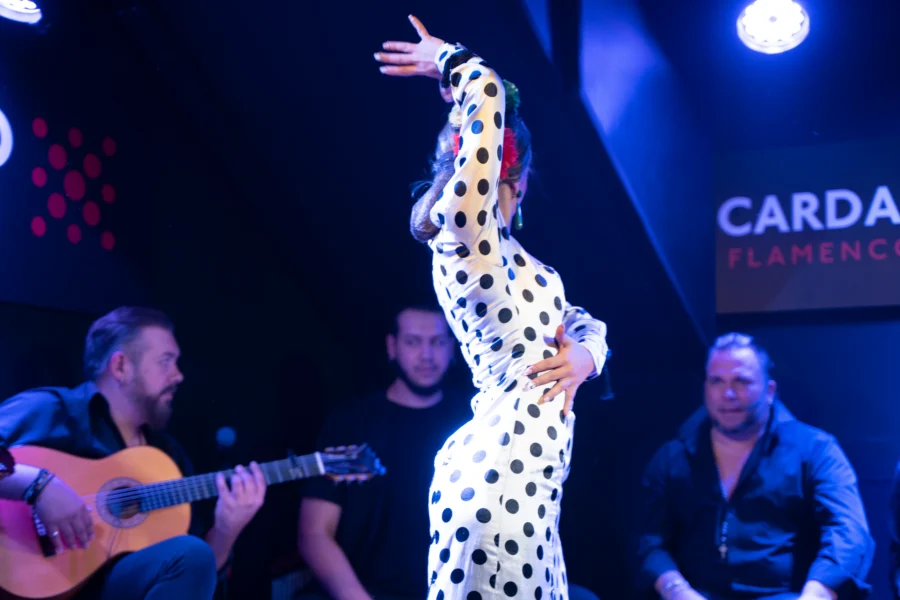
There is no party in Spain that does not surrender to them. Their structure of four verses is the ultimate magnet of any celebration, but behind the ruffles and the 3/4 time signature hides a history of centuries.
Understanding the origin of sevillanas is discovering how a dance that was born far from Seville ended up becoming the visual anthem of all Andalusia.
What are sevillanas
Unlike other more hermetic palos, sevillanas are the most popular regional dance in the world. It is a musical and choreographic composition divided into four fixed parts, where the coordination, the face-to-face and the final finish create a unique courtship narrative.
Although many people wonder what sevillanas are within the flamenco tree, technically they were born as a danceable folklore that, over time, became “flamenco-ized” until earning its place on professional stages and tablaos all over the world.
The origin of sevillanas: from Castilian seguidillas to Andalusia
The answer to where sevillanas come from usually surprises: their root is not purely Andalusian. The direct ancestor is the Castilian seguidillas, a popular dance that arrived in Seville in the time of the Catholic Monarchs.
Once those seguidillas touched Andalusian soil, the character of the south did the rest. They became slower, more elegant and were filled with that Sevillian grace that transformed them completely. It was in 1847, with the first April Fair, when they were officially baptized with the name we all know today.
Sevillanas and their relationship with flamenco
Although they were born from folklore, the origin of sevillanas is deeply linked to the jondo universe. During the 19th century, flamenco artists began to introduce turns, guitars and a much deeper way of singing, endowing them with a technical complexity they previously lacked.
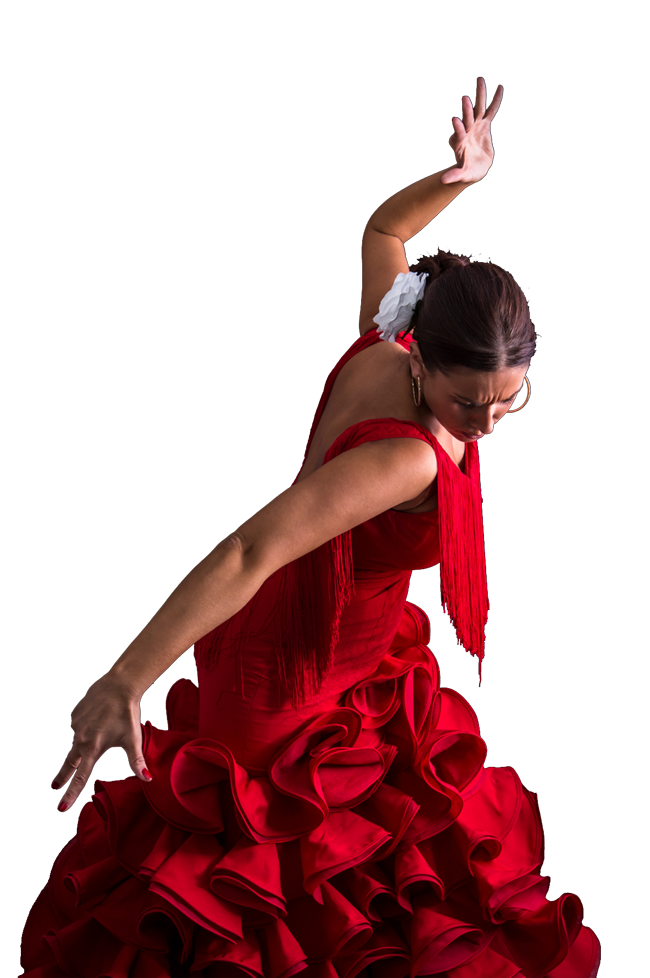
Today, a professional dancer can elevate a sevillana to the category of a work of art, demonstrating that the elegance of the arm movements and the strength of the footwork have nothing to envy a soleá or an alegría.
Evolution of sevillanas throughout history
Sevillanas are not a monolithic block; they have known how to adapt to every corner and moment in history through their different styles:
-
Traditional sevillanas: The lifelong ones, focused on the themes of love, the countryside and the city of Seville itself. They are the ones that maintain the purest structure.
-
Rocieras sevillanas: Born from the fervor of the Rocío Pilgrimage. They are usually accompanied by flute and tabor, with lyrics full of devotion and the journey.
-
Corraleras sevillanas: They were born in the old neighborhood courtyards. They are vibrant, fast and full of mischief, representing the joy of coexistence.
Buy tickets for the best flamenco show in MadridBuy tickets for the best flamenco show in Madrid. -
Boleras sevillanas: The most academic and technical version. Here is where the influence of classical dance and the masterful use of castanets are noticed.
Why sevillanas remain a cultural symbol of Andalusia
Despite the passing of the centuries, this dance remains more alive than ever. They have not been trapped in a museum; they have evolved with fashion, music and new generations. They are a symbol of identity that unites entire families and that allows anyone to participate in Andalusian culture.
Seeing sevillanas danced with soul is the perfect gateway to the world of flamenco. On our stage, we celebrate this evolution every night, elevating the popular to the extraordinary.
In our tablao, where every night you can enjoy a flamenco dinner show, we celebrate this evolution by elevating the popular to the extraordinary.