
Close your eyes and think of a flamenco show. You surely imagine the lament of a cantaor, the weeping of the guitar, or the fury of the zapateado. But you are wrong if you think that is the foundation. The true engine, the heartbeat that sustains all that magic, is almost invisible: flamenco clapping (las palmas).
They are not a simple ornament. They are the skeleton of the arte jondo. Read on and discover why this “human metronome” decides whether a performance fails or makes history.
What are flamenco palmas
Forget everything you know about clapping. Flamenco handclaps are not a random celebration; they are the most complex and precise percussion instrument of this art.
The palmeros transform their own hands into a perfect resonance box. Their mission is vital: they mark the rhythm, push the singer, and envelop the dancer. In flamenco, hands speak. They dictate the silences. And, above all, they trigger the energy of the entire group.
Types of Palmas
Not all hands sound the same. Nor are they used for the same purpose. Knowing the types of flamenco palmas and mastering them requires years of discipline. A bad palmero can ruin a genius; a good one lifts them to the heavens. They are divided into three fundamental weapons:
Palmas sordas (Muted claps)
The art of accompanying without disturbing. The hands are cupped to trap the air, achieving a low, deep, and respectful sound. Their exact moment? When the singer pours their heart out or the guitar seeks intimacy. They keep the pulse alive but never eclipse the voice.
Palmas abiertas (Open claps)
The thunder of the tablao. Also called palmas claras. The palm is struck with the fingers of the other hand well-stretched. The result is a sharp, brilliant sound capable of cutting through the room. They are only unleashed at the climax: during the fury of the zapateado or at the song’s closing. They are, literally, the fire of the performance.
Contratiempos (Off-beats)
This is where the amateurs are separated from the masters. It is not a sound; it is pure rhythmic mathematics. It consists of striking exactly on the weak beat, filling the gaps between the main beat. When one palmero carries the base and another crosses the contratiempos, the tension is electric. It is that frenetic sound that inevitably gives you goosebumps.
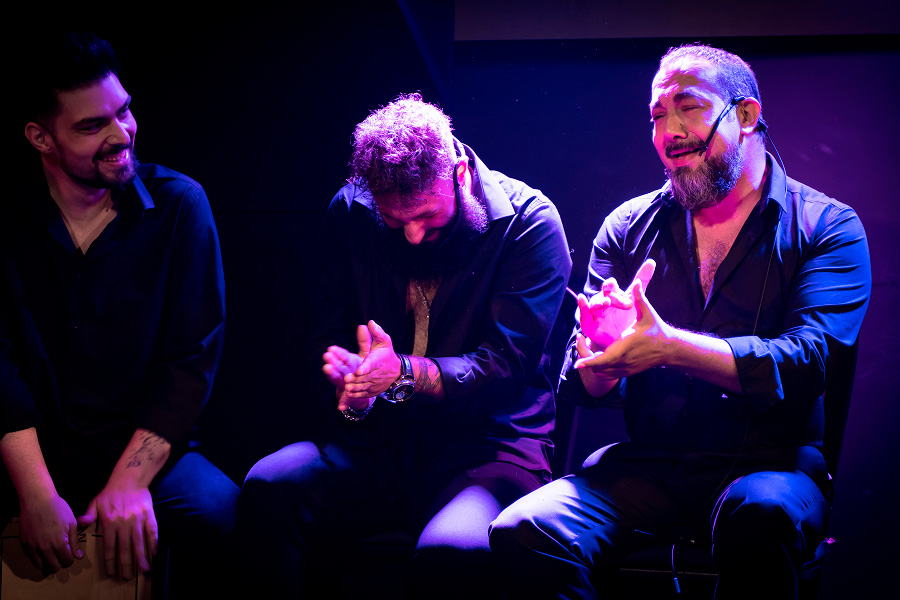
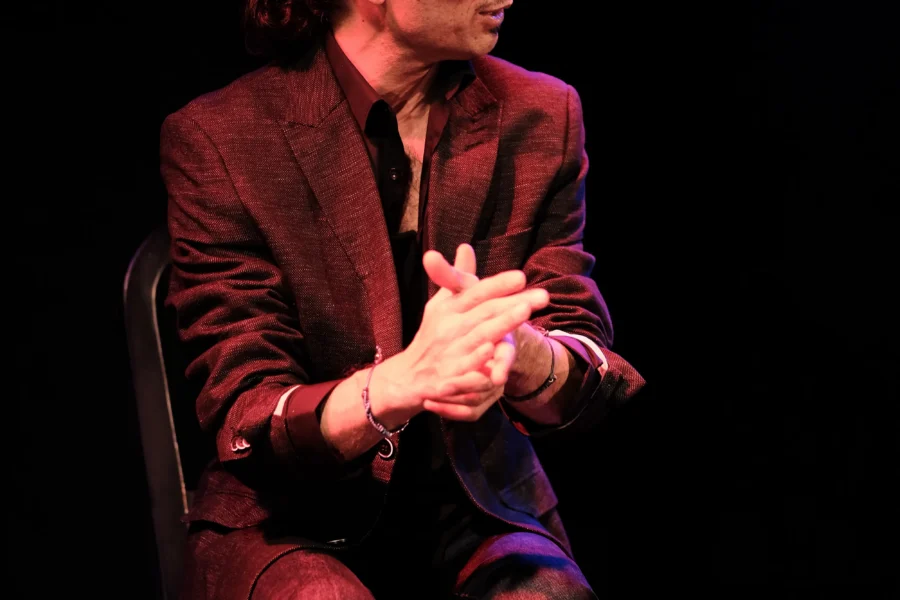
José del Calli and Antonio de Manuela keeping the rhythm with palmas at Cardamomo Flamenco Madrid
Las palmas and the flamenco rhythm
In a tablao, you won’t see a single music stand or sheet music. The only law is the compás, and the palmas are responsible for dictating it.
To succeed, the palmero must master the anatomy of the main flamenco styles. Sustaining the binary rhythm of tangos is nothing like taming the 12-beat clock of a bulería or a soleá. The palmero is the conductor. He ensures that no one, ever, falls into the void.
Why palmas are essential in a flamenco tablao
A dance without a floor. A guitar without strings. That’s how useless flamenco would be without palmas.
Live, the palmeros are the safety net for the entire group. They inject the “jaleo,” spark the adrenaline when the dancer demands it, and stop dead to let the singing breathe. They are the invisible thread that connects all the artists.
Don’t just read about it. If you want this ancient rhythm to strike your chest, come discover the best flamenco tablao in Madrid. Listen, feel, and experience how the hands of our masters ignite the night.